How to maintain your tankless water heater for years of use
A tankless water heater rewards regular maintenance. In Lakewood's moderately hard water, descaling and filter cleaning are the jobs that matter most, and a yearly service visit keeps the unit running the way it was designed to.
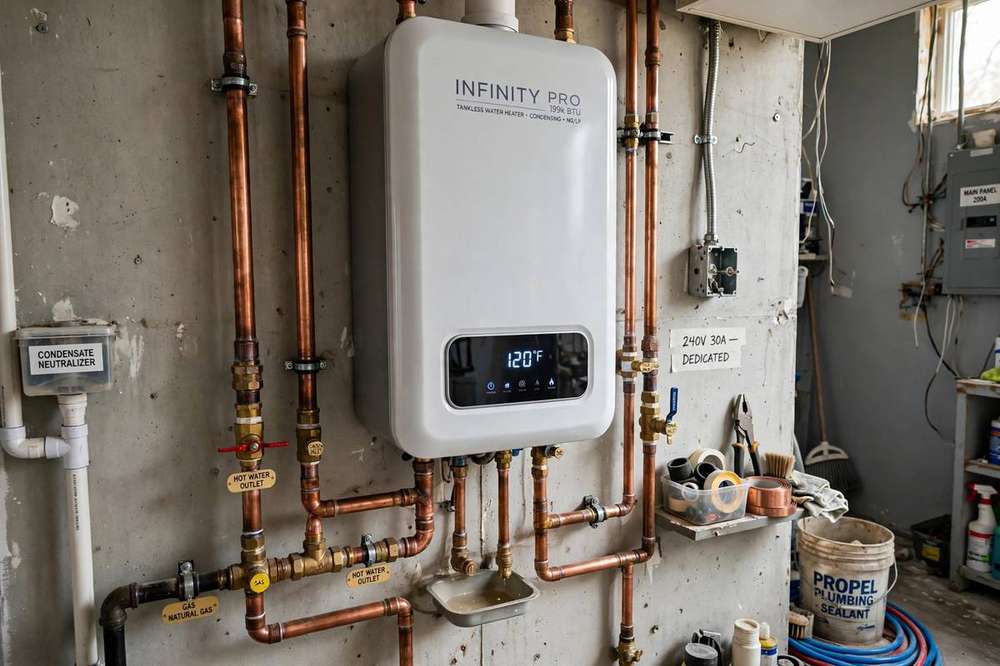
A tankless water heater has no tank to rust out, which is why it can serve a home for many years. What it has instead is a heat exchanger with narrow waterways, and those waterways are sensitive to scale. Lakewood's water is soft to moderately hard. Denver Water, which serves about sixty percent of Lakewood addresses, averages around 105 milligrams per liter of hardness, about 6.1 grains per gallon. That is not the hardest water in Colorado, but it is hard enough that scale builds up inside a heat exchanger over time, especially in a household that uses a lot of hot water. Maintenance is mostly about managing that scale, keeping the filters clean, and catching small problems before they become a no-hot-water call.
Why descaling matters in Lakewood
When water is heated, dissolved minerals come out of solution and settle as scale on hot surfaces. Inside a tankless heat exchanger, even a thin layer of scale insulates the water from the burner, so the unit has to work harder to reach the same temperature. The signs are gradual: hot water that takes longer to arrive, a temperature that fluctuates during a shower, error codes on the display, or a unit that shuts down under high demand. Left alone, scale shortens the life of the heat exchanger and can lead to a repair that costs far more than the maintenance that would have prevented it.
Descaling, sometimes called flushing, circulates a cleaning solution through the heat exchanger to dissolve the scale. How often it is needed depends on your water and your usage, and in Lakewood a yearly flush is a sensible routine for most households. Homes on a harder supply, or households with heavy hot-water use, may need it more often. A plumber can look at the scale in your unit and advise on the right interval for your home rather than a generic schedule. If you have a water softener, tell the technician, because softened water changes the descaling picture. Our water softener installation page explains how softening fits with tankless maintenance.
The inlet filter and the condensate drain
Most tankless units have a small inlet water filter that catches sediment before it reaches the heat exchanger. It is a simple part, but when it clogs, flow drops and the unit can behave as if the heat exchanger is scaled. Checking and cleaning the inlet filter is part of a routine service visit, and it is one of the first things a technician looks at when a unit is underperforming. If your unit has a cold-water filter housing, keep an eye on it and do not ignore a drop in hot-water flow.
Condensing tankless units also have a condensate drain, which carries away the acidic water produced when exhaust gases cool. That drain needs to stay clear, and the condensate neutralizer, if your unit has one, needs its media checked and replaced on schedule. A blocked condensate drain can shut the unit down, and a failed neutralizer can send acidic water into a drain that was not designed for it. Both are routine service items, and both are easy to miss if the unit is never opened up.
Venting and combustion air
A tankless water heater burns gas or uses a large electrical draw, and it needs a clear vent path and adequate combustion air. Once a year, look at the vent termination outside the house and make sure it is not blocked by leaves, snow, a bird's nest, or stored items. Inside, keep the area around the unit clear. Do not store paint, solvents, or cleaning chemicals near a gas appliance, and do not block the air intake. If you smell gas at any time, leave the property and call 911 and Xcel Energy first, then call a plumber. Never try to service a gas line or a gas valve yourself.
Lakewood sits at about 5,518 feet above sea level, and altitude affects gas appliances. Gas burners lose output with altitude, roughly about four percent per thousand feet above two thousand feet, so a unit rated at sea level delivers less heat here. That matters when a unit is sized for a home, and it is one reason a tankless unit that seems adequate on paper can struggle when two showers and a dishwasher run at once. If your unit cannot keep up, the answer is not always a bigger unit. A technician can check whether scale, a clogged filter, or gas supply is the real limit before recommending a change. See our tankless water heater installation page for how sizing works in Lakewood.
What a yearly service visit covers
A proper yearly service for a tankless unit in Lakewood covers the descaling flush, cleaning the inlet filter, checking the condensate drain and neutralizer, inspecting the venting and combustion air, checking the gas supply and burner operation, and testing the temperature controls and safety devices. The technician should also look at the isolation valves, which are what make the flush possible. If your unit was installed without isolation valves, flushing is much harder, and adding them is worth discussing at the service visit.
Keep a record of each service: the date, what was flushed or replaced, and any error codes that appeared during the year. That record helps the next technician, and it gives you a clear picture of whether the unit is holding up or starting to need more attention. If error codes keep returning after a flush, or the unit needs descaling far more often than expected, the water supply or the installation may need a closer look.
What not to do
Do not open the gas side of the unit, do not adjust gas pressure, and do not try to descale a unit that has no isolation valves by improvising a connection. Descaling involves circulating a cleaning solution through the heat exchanger, and doing it wrong can leave solution in the water lines or damage the unit. If your unit has isolation valves and the manufacturer provides a homeowner flush procedure, follow it exactly and use only the cleaning solution the manufacturer specifies. If you are unsure at any point, stop and call a plumber. A service visit is a routine job, and it is far simpler than repairing a unit that has been flushed incorrectly.
Do not ignore the warning signs either. Fluctuating temperature, longer waits for hot water, unusual noises, or error codes are the unit telling you it needs attention. A tankless heater that is maintained on schedule is a reliable appliance. One that is ignored will eventually stop on the coldest morning of the year, which is when you least want to be without hot water.
If your tankless unit is due for its yearly service, or it is already showing signs of scale, call Emergency Plumber Lakewood at (720) 909-6690. We service tankless water heaters across Lakewood, open 24 hours, every day. Our water heater repair page covers what happens when a unit needs more than maintenance.
Get help with plumbing in Lakewood
If you would rather have a plumber take it from here, call Emergency Plumber Lakewood at (720) 909-6690. We serve homes across Lakewood, and we are open 24 hours, every day.
Your questions, answered
How often should a tankless water heater be descaled in Lakewood?
Yearly descaling is a sensible routine for most Lakewood households, because the water is soft to moderately hard at about 105 milligrams per liter. Homes with heavy hot-water use or a harder supply may need it more often. A plumber can advise on the right interval after seeing the scale in your unit.
What are the signs my tankless water heater needs maintenance?
Hot water that takes longer to arrive, temperature that fluctuates during a shower, a drop in flow, unusual noises, or error codes on the display. Any of those is a reason to book a service visit rather than waiting for the unit to stop.
Can I descale my tankless water heater myself?
Only if your unit has isolation valves and the manufacturer provides a homeowner flush procedure, and only by following that procedure exactly with the specified cleaning solution. Never open the gas side of the unit or improvise a flush connection. If you are unsure, call a plumber.
Does Lakewood's altitude affect a tankless water heater?
Yes. Lakewood sits at about 5,518 feet, and gas burners lose output with altitude, roughly about four percent per thousand feet above two thousand feet. That affects how a unit is sized and how it performs when several hot-water fixtures run at once.
Does a water softener help a tankless water heater?
Yes. Softened water forms far less scale inside the heat exchanger, which can extend the time between descaling flushes. A plumber can advise whether softening makes sense for your home and your water supply.
Sources
- Denver Water — The hard truth about soft water — Denver Water hardness figures cited in this guide.
- Denver Water — Water quality reports — published water-quality data for Denver Water customers.