Sewer line repair vs replacement: which is right for your home?
Repair keeps the existing pipe and fixes the damaged section. Replacement installs a new line. In Lakewood, the deciding factors are pipe material, how far the damage extends, and what a camera inspection actually shows.
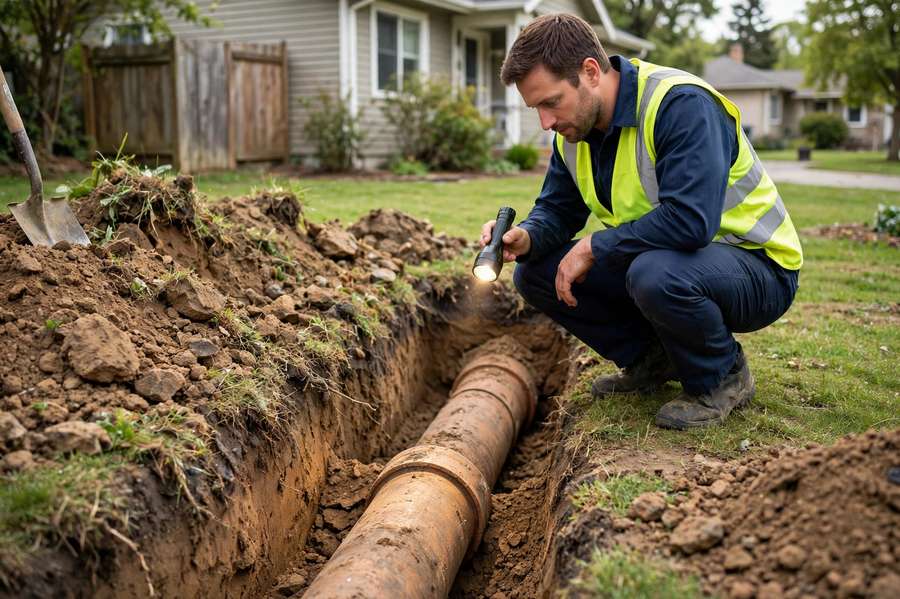
Few plumbing decisions feel as large as the one about a sewer line. The pipe is buried, the work is disruptive, and the difference between a repair and a replacement is significant. The good news is that the decision does not have to be a guess. A camera inspection shows the pipe's condition from the inside, and once you can see the pipe, the choice between repair and replacement usually becomes clear. This guide explains how that decision works in Lakewood, what your pipe material means, and what the trenchless options involve.
Start with a camera inspection, always
A camera inspection is the first step for any sewer line decision, and it is the step that should never be skipped. A small camera on a flexible cable is run through the line from a cleanout or a fixture, and the picture shows exactly what is wrong and where. Roots at a joint, a belly where the pipe sags, a crack, an offset joint, a collapsed section, or a pipe that is simply worn out all look different on camera, and each one points to a different fix. Without a camera, a plumber is guessing, and a homeowner is being asked to approve work based on a guess.
The camera also measures distance, so the plumber knows whether the problem is under the front lawn, under the driveway, or under the street. That matters, because the location of the damage affects the work as much as the damage itself. In most Lakewood districts the homeowner owns the sewer lateral from the house all the way to the district main, including the section under the sidewalk and street, so knowing where the problem sits is part of knowing what the job involves. Our sewer camera inspection page explains how the inspection works and what the footage shows.
What Lakewood's older pipes mean for the decision
Lakewood's housing stock is old enough that pipe material is a real factor in the decision. The citywide median year built is 1977, and about fifty-six percent of homes were built before 1980. Homes built before 1970 typically have vitrified clay tile sewer laterals, laid in short sections with a joint every few feet. Orangeburg pipe, a tar-impregnated fibre pipe, was installed from the 1940s to the early 1970s and it ovals and collapses with age. Cast-iron laterals are also common in mid-century homes.
Lakewood's soil adds to the wear. Much of the Denver metro, including Lakewood, sits on expansive bentonite clay that swells when wet and shrinks when dry. That seasonal movement stresses buried pipe joints, creates bellies where a line sags and waste settles, and can crack older clay or Orangeburg pipe. Mature cottonwoods, elms, and silver maples planted in the 1950s and 1960s send roots toward any joint that weeps moisture. A pipe that was sound twenty years ago can be a root-filled, bellied, offset line today, and the camera is what reveals that change.
When repair is the right answer
Repair is the right answer when the damage is limited and the rest of the pipe is sound. A single cracked section, one offset joint, a localized root intrusion, or a short belly in an otherwise solid line can be fixed with a spot repair. The damaged section is exposed, cut out, and replaced with new pipe, and the rest of the line stays in place. Repair also makes sense when the problem is a root intrusion that can be cleared and the pipe itself is intact, provided the roots are dealt with on a maintenance schedule rather than ignored until they block the line again.
Repair has limits. A spot repair on a clay line with joints every few feet fixes one joint, and the next joint may be the one that fails next year. If the camera shows roots at several joints, or the pipe is already bellied in more than one place, a single repair is a temporary fix. A good plumber will say so plainly and show you the footage, so the decision is based on the condition of the whole line, not just the worst spot. See our sewer line repair page for how a spot repair is done.
When replacement is the right answer
Replacement is the right answer when the pipe is failing along its length rather than in one place. Orangeburg pipe that has ovaled or collapsed can only be replaced, because there is no sound pipe left to repair. A clay line with roots at most joints, multiple bellies, and offset sections is usually better replaced than repaired joint by joint. A line that has already been repaired more than once, and keeps failing in new places, is telling you the material has reached the end of its life. Replacement installs a new line, usually PVC or HDPE, with far fewer joints for roots to enter and a much longer expected service life.
Replacement also makes sense when the line is shallow enough or accessible enough that the work is straightforward, or when the alternative is a series of repairs that add up to the same disruption. Permits are required for sewer replacement in Lakewood, and the work must meet the 2021 International Plumbing Code as adopted by the city. Your plumber should handle the permit and the inspection, and should confirm any district requirements for the connection at the main. Our sewer line replacement page covers what the job involves.
Trenchless options
Replacement does not always mean an open trench from the house to the street. Trenchless methods can install a new line with far less digging. In pipe bursting, a new pipe is pulled through the old line, breaking the old pipe outward as it goes. In cured-in-place lining, a resin-soaked liner is inserted into the existing pipe and cured to form a new pipe inside the old one. Both methods have conditions. Pipe bursting needs space for the pulling equipment and a line that can be broken apart. Lining needs a host pipe that is still round enough to hold the liner, and it slightly reduces the inside diameter of the line. Neither method is right for every line, and a camera inspection is what determines whether a trenchless option is possible for your home. Our trenchless sewer repair page explains both methods and their limits.
How to decide
Ask for three things before you decide: the camera footage, a written description of what the camera showed and where, and a written scope of work for each option, repair and replacement, so you can compare them on the same terms. Ask how much of the line is affected, what material the existing pipe is, and whether the problem is likely to recur. If a plumber recommends replacement, ask to see the footage that supports it. If a plumber recommends repair, ask what happens if the next joint fails.
There is no universal right answer. A single cracked section in a sound line is a repair. A collapsed Orangeburg line is a replacement. Most Lakewood homes fall somewhere between those two, and the camera footage is what places your home on that scale. If you would like us to run a camera inspection and talk through the options, call Emergency Plumber Lakewood at (720) 909-6690. We are open 24 hours, every day.
Get help with plumbing in Lakewood
If you would rather have a plumber take it from here, call Emergency Plumber Lakewood at (720) 909-6690. We serve homes across Lakewood, and we are open 24 hours, every day.
Questions, answered
Do I need a camera inspection before deciding between sewer repair and replacement?
Yes. A camera inspection shows exactly what is wrong, where it is, and how much of the line is affected. Without it, any recommendation is a guess. The footage is what places your line on the scale between a spot repair and a full replacement.
When is sewer line repair enough in Lakewood?
Repair is enough when the damage is limited and the rest of the pipe is sound, such as a single cracked section, one offset joint, or a localized root intrusion in an otherwise solid line. If the camera shows roots at several joints or bellies in more than one place, a single repair is usually temporary.
When does a sewer line need replacement instead of repair?
Replacement is the answer when the pipe is failing along its length, such as Orangeburg pipe that has ovaled or collapsed, a clay line with roots at most joints and multiple bellies, or a line that has already been repaired more than once and keeps failing in new places.
What is trenchless sewer repair?
Trenchless methods install a new line with far less digging. In pipe bursting, a new pipe is pulled through the old line. In cured-in-place lining, a resin liner is inserted into the existing pipe and cured to form a new pipe inside the old one. A camera inspection determines whether either method is possible for your line.
Who owns the sewer lateral in Lakewood?
In most Lakewood districts the homeowner owns the sewer lateral from the house all the way to the district main, including the section under the sidewalk and street. Confirm the rule with your own sanitation district if you are unsure.
Sources
- Lakewood Municipal Code, Chapter 14.05 — 2021 International Plumbing Code — the code sewer replacement work in Lakewood must meet.
- City of Lakewood — Permit types information sheet — which plumbing jobs need a permit in Lakewood.