Open 24 hours
Call any hour, any day — the phone is answered around the clock.
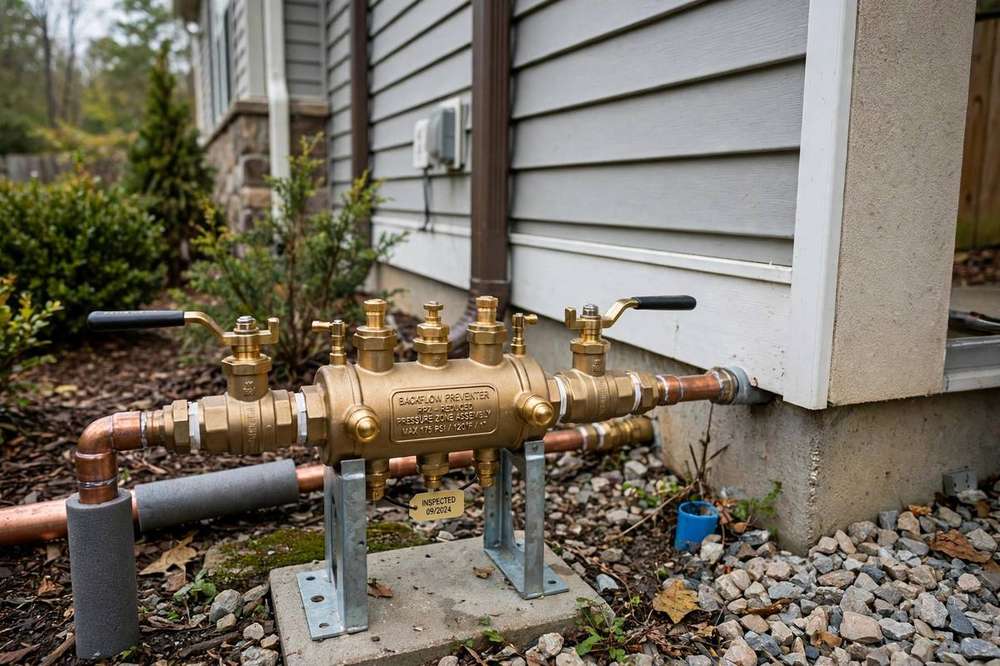
Backflow testing in Lakewood, CO is the annual test of the assembly that stops water from flowing backwards from your property into the drinking water supply. When pressure drops — a main break, a fire hydrant in use, a heavy irrigation draw — water can reverse direction, and anything it picks up on the way back goes toward the public supply. The test proves the assembly still holds. It is done by a certified tester with calibrated equipment, and the results are filed with the water provider that serves your address.
Call any hour, any day — the phone is answered around the clock.
We explain what we found and what the options are before work starts.
Equipped vehicles and a clean job site when we leave.
A Lakewood business at 200 Union Blvd — neighbors serving neighbors.
Testing is a compliance job with a paper trail: the test, the result, and the filing. Here is what it covers.
Testing of the testable backflow assembly on your property by a certified tester, using calibrated equipment.
The most common residential trigger — the assembly on a sprinkler or irrigation system, tested before the watering season.
If the assembly fails the test, the repair or replacement that brings it back into compliance, then a re-test.
Testing and certification of a newly installed assembly, so the install is on record with the provider.
Test results are filed with the water provider that serves your address — Denver Water, Consolidated Mutual, or one of the other districts.
The test is annual, and the next one is due a year after the last — we note the date so the notice does not catch you out.
Call (720) 909-6690 — open 24 hours, every day — and tell us what is happening.
Backflow is water flowing the wrong way — from your property back into the public drinking water supply — and the test proves the device that stops it still works.
It happens when pressure drops on the supply side: a water main break, a hydrant opened for firefighting, or a heavy draw on the system. The pressure reversal can pull water backwards through a cross-connection — an irrigation system, a boiler feed, a pool fill line, a fire sprinkler system — and anything that water picks up on the way back heads toward the public supply. That is why the assembly is testable, and why the test is annual: the internal checks and relief valves wear, and a device that held last year may not hold this year. The test is done by a certified tester with calibrated equipment — it is not a homeowner job, and this page gives no do-it-yourself testing guidance. Our water softener installation page covers the treatment side of the same water system.
Lakewood has no single water provider and no single citywide deadline, and that is the fact that catches homeowners out. The provider follows the address — Denver Water serves about 60 percent of the city, and Consolidated Mutual, Bancroft-Clover, Green Mountain, Bear Creek, Alameda, Daniels, and a small City utility serve the rest — and each provider runs its own programme, with its own notice and its own filing. The notice arrives from your provider, the test is annual, and the results are filed with that provider. Irrigation systems are the most common residential trigger, which is why the test belongs on the calendar before the watering season, not after it. If you have had a notice and do not know which provider serves you, the address decides it — and the provider's name is on your water bill.

The provider follows the address — Denver Water, Consolidated Mutual, or one of the other districts. The name is on your water bill, and the notice comes from them.
We find the testable assembly — usually on the irrigation system, and sometimes on a boiler feed, pool fill, or fire sprinkler line.
A certified tester runs the annual test with calibrated equipment, checking the assembly's valves and relief against the standard.
If the assembly fails, it is repaired or replaced, then re-tested until it passes.
The test results are filed with your water provider, and the next test date is noted — a year from this one.
The test kit is calibrated, because the result is a compliance record, not an estimate.
Annual testing by a certified tester — the qualification the providers require.
Finding the testable assembly and the cross-connections it protects, from irrigation to boiler feed.
The checks, springs, and seals that bring a failed assembly back into compliance.
Results filed with the provider that serves the address, in the form that provider asks for.
Testing scheduled before the irrigation season, when the assembly is about to work hardest.
The assembly on the sprinkler system is due its annual test. The test is run, the results are filed with Denver Water, and the system is cleared for the season.
The provider follows the address, and each provider runs its own programme. The test is done to that provider's notice and filed with them — not to a citywide date that does not exist.
The internal checks no longer hold. The assembly is repaired, re-tested until it passes, and the passing result is filed — the system is back in compliance.
Lakewood's fragmented water system is the backflow story. There is no single provider, no single deadline, and no single form: Denver Water serves about 60 percent of the city, and Consolidated Mutual, Bancroft-Clover, Green Mountain, Bear Creek, Alameda, Daniels, and a small City utility serve the rest. Each runs its own programme, and the notice — and the filing — follow the address. Irrigation is the residential trigger almost every time, and the test belongs before the watering season.
Homes with irrigation systems on sloped lots, where the assembly protects the supply from the sprinkler lines.
Planned-community homes with irrigation systems that are the most common residential trigger.
Homes served by Green Mountain's district, with its own provider programme and notice.
Large lots with irrigation and hose-bibb lines that need a testable assembly between them and the supply.
Horse-property lots with barn and paddock water lines that add cross-connections to test.
Denver Water, Consolidated Mutual, and the other districts each run their own programme.
Sprinkler and irrigation systems are the most common residential reason a home has an assembly.
The notice comes from your provider — there is no citywide test date.
The test belongs on the calendar before the watering season, not after it.
Before: a Denver Water notice arrives and the irrigation system cannot legally run until the assembly passes.
After: the annual test is run, the results are filed, and the sprinklers start the season in compliance.
Maintenance: The next test is due a year from this one — note the date when the notice arrives, not when the season starts.
Before: a homeowner expects a citywide deadline and misses their provider's notice.
After: the provider is identified from the water bill, the test is done to that provider's notice, and the results are filed with them.
Maintenance: The provider follows the address. The notice follows the provider.
Before: an assembly fails its annual test and the irrigation system is out of compliance.
After: the assembly is repaired, re-tested until it passes, and the passing result is filed.
Maintenance: A failed test is a repair, not a fine — as long as the re-test follows promptly.
Backflow work is compliance work, and the problems are the gaps in the compliance chain. These are the ones we close.
A testable assembly that has never been tested is an unknown. The annual test establishes its condition and puts it on record.
A homeowner has a notice and does not know which provider sent it. The address decides the provider, and the water bill names it.
An assembly whose checks no longer hold. Repair or replacement, then a re-test until it passes.
The most common residential gap: the sprinklers run before the assembly is tested. The test belongs before the season.
A newly installed assembly needs testing and certification to be on record with the provider.
Backflow testing is a small job with a large consequence: it is the test that stands between your irrigation system and the drinking water supply. The discipline is the filing, not just the test.
Emergency Plumber Lakewood holds a 5.0-star rating from 9 Google reviews. Homeowners across Lakewood call us when a main line fails, a water heater quits, or a drain will not clear — and the reviews describe the same things we aim for on every visit: a clear explanation of what is wrong, the options before work starts, and a clean job site when we leave. Call (720) 909-6690 — open 24 hours, every day — to talk through what is happening at your home.
It is the annual test of the assembly that stops water flowing backwards from your property into the public drinking water supply. When pressure drops — a main break, a hydrant in use — water can reverse, and the test proves the assembly still holds.
Annually. There is no single citywide deadline — the provider that serves your address runs its own programme and sends its own notice. The test is due every year, and the results are filed with that provider.
The provider follows the address. Denver Water serves about 60 percent of the city, and Consolidated Mutual, Bancroft-Clover, Green Mountain, Bear Creek, Alameda, Daniels, and a small City utility serve the rest. The provider's name is on your water bill.
No. Testing must be done by a certified tester with calibrated equipment, and the results are filed with your water provider. It is a compliance test, not a homeowner job.
Not seeing your question? Call (720) 909-6690 — open 24 hours, every day — and talk it through with the local team.
Ask the local teamReach us any hour at (720) 909-6690. Tell us which provider sent the notice and what system the assembly protects, and we will talk through the next step.