Open 24 hours
Call any hour, any day — the phone is answered around the clock.
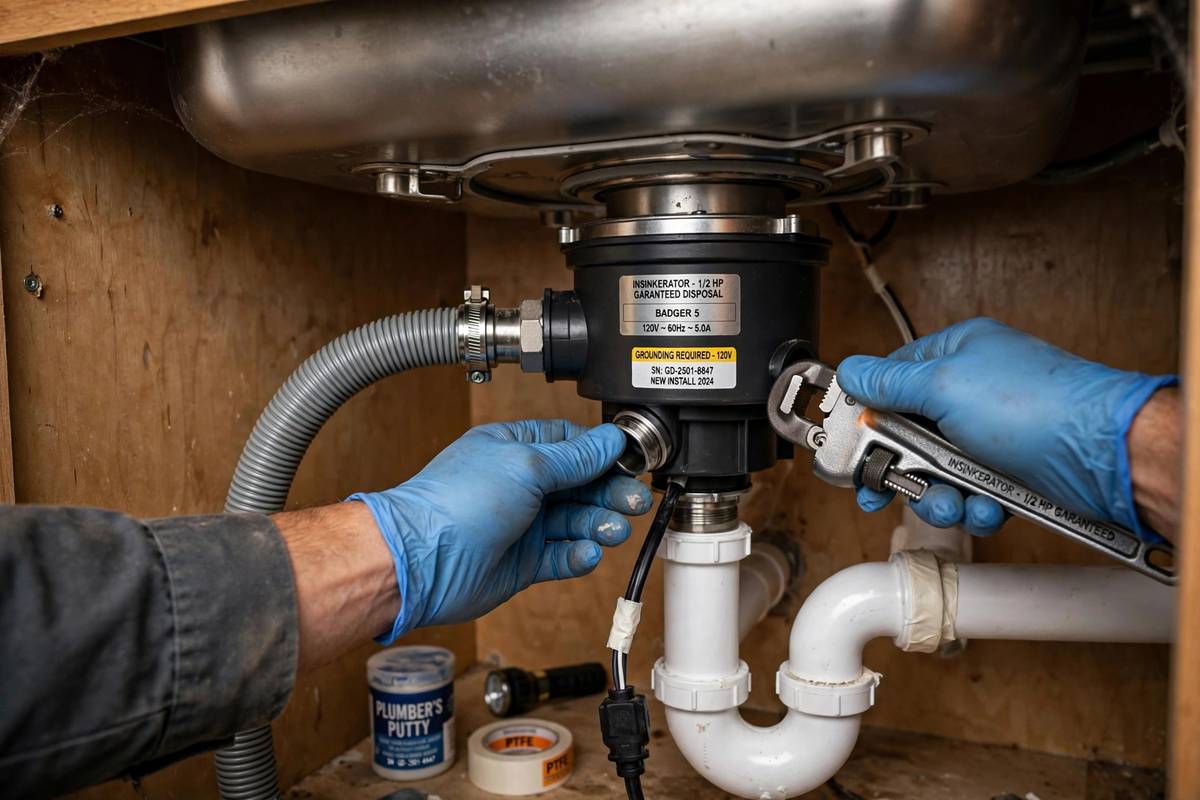
Garbage disposal installation in Lakewood, CO covers the small kitchen fixture that causes an outsized share of kitchen calls: the disposal that hums without turning, the one that leaks from the bottom, and the one that has simply reached the end of its service life. This page covers both installation and repair, because the honest answer is often a repair — a reset, a cleared jam, a new seal — and a replacement only when the unit itself has failed. If the jam is really a drain blockage, we say so and send you to the drain page.
Call any hour, any day — the phone is answered around the clock.
We explain what we found and what the options are before work starts.
Equipped vehicles and a clean job site when we leave.
A Lakewood business at 200 Union Blvd — neighbors serving neighbors.
A disposal job is a fit, a connection, and a test — and the judgment about whether the unit needs replacing at all. Here is what it covers.
A new disposal fitted to the existing sink and drain, with the electrical connection checked and the drain tested.
Removing a failed unit and fitting its replacement, with the mounting, seals, and drain connections renewed.
A jammed disposal is often a repair: the jam is cleared, the reset is tested, and the unit is checked for damage before any replacement is discussed.
Leaks from the sink flange, the dishwasher connection, or the drain tailpiece — traced to the seal that has failed and repaired there.
The dishwasher drain connection checked and fitted, because a disposal install that ignores it is an install that leaks later.
A disposal replacement that pairs with a sink or faucet job — see our fixture installation page — fitted in the same visit.
Call (720) 909-6690 — open 24 hours, every day — and tell us what is happening.
A garbage disposal grinds food waste at the kitchen sink and flushes it down the drain — and in Lakewood's 1960s and 70s kitchens, the disposals are often as old as the sink they sit under.
The symptoms are familiar: the unit hums without turning, which is usually a jam; it leaks from the bottom, which is usually a failed seal or a cracked housing; it trips the reset, which is usually an overload or a failing motor; or it drains slowly, which may not be the disposal at all — a slow drain with a working disposal is a drain blockage, and our drain cleaning page is the right call for that. Grease and hard-water scale contribute to jams and slow drains in Lakewood kitchens, and a disposal that is used as a trash can — bones, fibrous vegetables, coffee grounds in quantity — jams more than one that is used as it was designed. The repair-or-replace question is answered with the unit open: a jam or a seal is a repair; a cracked housing or a burned-out motor is a replacement.
The install itself is straightforward but unforgiving of shortcuts: the mounting flange sealed to the sink, the dishwasher connection fitted, the drain tailpiece aligned so it does not stress the seals, and the electrical connection checked before the unit is switched on. A disposal replacement often pairs with a sink or faucet job — the sink is already open, the water is already off, and the connections are already in hand — and our fixture installation page covers that side of the kitchen. No brand is named on this page, because no supply status has been confirmed: the unit is chosen for the sink and the household, not a label.
We check whether the problem is the disposal, the drain, or the electrical supply — a slow drain with a working disposal is a drain call.
A jam is cleared, a seal is replaced, a reset is tested. A cracked housing or a burned-out motor means replacement, and we say so with the unit open.
The old unit is removed, the mounting flange is sealed to the sink, and the new unit is fitted with renewed seals and drain connections.
The dishwasher connection is fitted, the drain tailpiece is aligned, the electrical connection is checked, and the unit is run under water.
We show you what the disposal handles and what jams it — and where the reset button is for the next time it trips.
Clear a jammed disposal without damaging the grinding plate or the motor.
New seals at the flange, the dishwasher connection, and the drain — the leak points, renewed on every install.
For the drain work underneath the sink, which is part of the disposal job, not a separate call.
Checks the supply to the disposal before the unit is switched on, and traces a dead unit to the supply or the motor.
Fit the mounting flange to the sink and align the drain tailpiece so the seals are not stressed.
When a slow drain is really a blockage past the disposal, the camera finds it.
A jam — often a bone or a fibrous vegetable wedged in the plate. The jam is cleared, the reset is tested, and the unit runs again without a replacement.
The seal at the flange has failed, or the housing is cracked. The leak is traced to the seal that failed, and the repair or replacement follows from what is found.
The sink is already open and the water is already off, so the aging disposal is replaced in the same visit — one call, one clean job site.
Lakewood's disposals age with its kitchens. The 1960s and 70s kitchens across the city carry original or early-replacement disposals, and grease plus moderately hard water scale contribute to the jams and slow drains that bring the calls. A disposal replacement is often the second half of a sink or faucet job, and the two are planned together.
1960s kitchens where the disposal is as old as the sink it sits under.
1960s ranches where a disposal replacement pairs with a sink and faucet job.
Mid-century kitchens where grease and scale contribute to jams and slow drains.
1970s split-levels where the kitchen disposal and the lower-level drains are the same visit.
Older kitchens beside newer infill, where the disposal era decides repair vs replacement.
Kitchen grease coats drains and contributes to jams and slow drains.
Around 105 mg/L, about 6.1 grains per gallon — scale contributes to slow drains.
Original and early-replacement disposals reaching the end of their service life.
A disposal replacement that pairs with a sink or faucet job is fitted in the same visit.
Before: a disposal hums without turning, and the homeowner expects a replacement.
After: the jam is cleared, the reset is tested, and the unit runs again — a repair, not a replacement.
Maintenance: Feed the disposal cold water and small amounts at a time. A jam is usually a use problem, not a unit problem.
Before: a disposal leaks from the bottom every time it runs.
After: the failed seal is found and replaced, the drain is tested under pressure, and the cabinet stays dry.
Maintenance: A leak that returns is a different seal — the flange, the dishwasher connection, and the tailpiece are all checked.
Before: a sink is being replaced and the aging disposal sits underneath it.
After: the disposal is replaced in the same visit, with new seals and a checked dishwasher connection.
Maintenance: One visit, one clean job site — and a disposal that matches the new sink's life, not the old one's.
A disposal has a short list of failures, and each one points to a different answer. These are the ones we see.
A jam, usually. The jam is cleared and the reset is tested — a replacement is the last resort, not the first.
A failed seal or a cracked housing. The leak is traced to the seal that failed, and the repair or replacement follows from what is found.
An overload or a failing motor. The load is checked first; a motor that trips under normal load is a replacement.
A slow drain with a working disposal is a drain blockage, not a disposal problem — and the drain page is the right call.
No hum, no response: the electrical supply or the motor. The supply is tested before the unit is condemned.
A disposal is the smallest job on this site, and the easiest to oversell: a jam is not a replacement, and a slow drain is not a disposal problem. The judgment is the job.
Emergency Plumber Lakewood holds a 5.0-star rating from 9 Google reviews. Homeowners across Lakewood call us when a main line fails, a water heater quits, or a drain will not clear — and the reviews describe the same things we aim for on every visit: a clear explanation of what is wrong, the options before work starts, and a clean job site when we leave. Call (720) 909-6690 — open 24 hours, every day — to talk through what is happening at your home.
Usually not — it is usually jammed. The jam is cleared and the reset is tested, and the unit often runs again without a replacement. A disposal that hums is a disposal whose motor still works.
A leak comes from a failed seal — at the sink flange, the dishwasher connection, or the drain tailpiece — or from a cracked housing. We trace the leak to the seal that failed; a seal is a repair, a cracked housing is a replacement.
Not necessarily. A slow drain with a working disposal is a drain blockage, and our drain cleaning page is the right call. The disposal grinds waste; it does not clear the drain past it.
Yes — and it is usually the sensible way to do it. The sink is already open and the water is already off, so the disposal is replaced in the same visit. See our fixture installation page for the sink side of the job.
Not seeing your question? Call (720) 909-6690 — open 24 hours, every day — and talk it through with the local team.
Ask the local teamReach us any hour at (720) 909-6690. Tell us what the disposal is doing — humming, leaking, tripping, or draining slowly — and we will talk through the next step.